I graduated from the University of Electronic Science and Technology of China (UESTC) with a Bachelor of Engineering in Spatial Informatics and Digitalized Technology. After that, I joined the Energy and Environment Group (EEG) in the Department of Computer Science and Technology, University of Cambridge, as an Undergraduate Research Assistant under the supervision of my advisor, Srinivasan Keshav. Now, I am a PhD student under his supervision.
My research interest lies at the intersection of AI and Earth Science. I am particularly interested in developing Self-Supervised Learning (SSL) algorithms for remote sensing imagery.
I am also the co-founder and president of the China Artificial Intelligence Association (Cambridge). We are dedicated to creating a platform for AI communication that integrates academia and industry, connecting universities in China and the UK to build a cross-national AI talent ecosystem.
My main work at present is developing a remote sensing foundation model called TESSERA. We have found some exciting results. We were recently recruiting for an RA position to create a global habitat map using TESSERA. (The position has been filled, but we welcome any informal chat at zf281@cam.ac.uk if you are interested).
We are also currently recruiting a Postdoctoral Research Associate to join our team! The position will use TESSERA to track biodiversity, carbon storage and woodland regeneration at scale, directly informing real-world nature recovery in the UK. Ideal candidates should have (or be finishing) a PhD in land use, ecosystems or environmental science, work confidently with geospatial data and code, and be excited by AI and nature-based solutions. Apply here (Closing date: 12 January 2026).
We would like to express our gratitude to DAWN, the fastest artificial intelligence supercomputer at Cambridge, for their generous support in this project. We also acknowledge the support from AMD, Vultr, Microsoft AI For Good Lab, dClimate, and Amazon Web Services (AWS). This work would not have been possible without their computational resources and technical assistance.
🔥 News
- 2026.02: 🎉🎉 Our TESSERA paper was accepted by CVPR 2026.
- 2026.01: 🎉🎉 I was honored to be invited to the AI for Good Global Summit (to be held in Geneva, Switzerland, in July 2026), where I will present TESSERA-related works.
- 2025.12: 🎉🎉 I was honored to be invited by IEEE GRSS to give a talk about TESSERA. Information and recording can be found here.
- 2025.11: 🎉🎉 I was invited as a keynote speaker to the Open-Earth-Monitor Global Workshop 2026, which will be held in Barcelona, Spain, from 7–9 October 2026. The event is co-hosted by CREAF and the OpenGeoHub Foundation under the Open-Earth-Monitor-Cyberinfrastructure (OEMC) project.
- 2025.09: 🎉🎉 I was honored to participate in the 13th Heidelberg Laureate Forum as a young researcher and presented the TESSERA work (Heidelberg Laureate Forum).
- 2025.07: 🎉🎉 We have open-sourced the inference code for TESSERA and the code for using embeddings in downstream tasks (GeoTessera). We will be rolling out a global 10m resolution annual embedding product in the coming months.
- 2025.06: 🎉🎉 We have released the preprint of our latest work, TESSERA. We trained a 14B model to extract time-series spectral features from satellite images.
- 2025.03: 🎉🎉 Our app, GreenLens, won the Better Future Award from the Cambridge Ring!
- 2025.02: 🎉🎉 We published “SPREAD: A large-scale, high-fidelity synthetic dataset for multiple forest vision tasks” in Ecological Informatics. We used Unreal Engine 5 to create the most realistic synthetic data for 2D and 3D vision tasks in forests.
- 2024.10: 🎉🎉 I am thrilled to be fully funded to join the EEG, Department of Computer Science and Technology, University of Cambridge, as a PhD student.
- 2024.09: 🎉🎉 “An app for tree trunk diameter estimation from coarse optical depth maps,” was accepted by Ecological Informatics.
📝 Publications
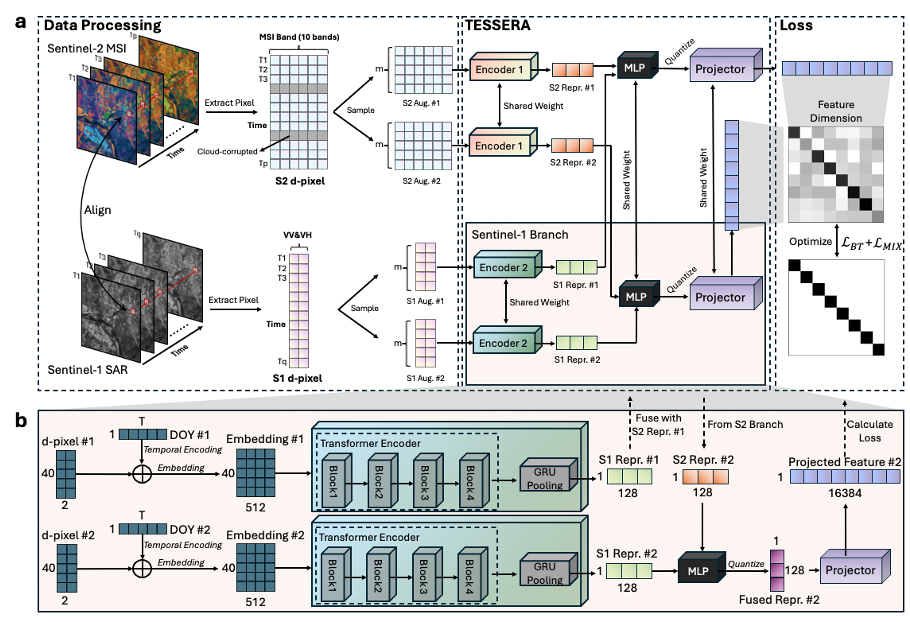
TESSERA: Temporal Embeddings of Surface Spectra for Earth Representation and Analysis




Zhengpeng Feng, Clement Atzberger, Sadiq Jaffer, Jovana Knezevic, Silja Sormunen, Robin Young, Madeline C. Lisaius, Markus Immitzer, Toby Jackson, James Ball, David A. Coomes, Anil Madhavapeddy, Andrew Blake, Srinivasan Keshav
- We trained a 1.4B model to extract time-series spectral features from satellite images.
- We are releasing 2.5PB of global 10m-resolution earth embeddings from 2017-2025.
- Researchers from over 50 groups worldwide are using TESSERA.
- Accepted by CVPR 2026.
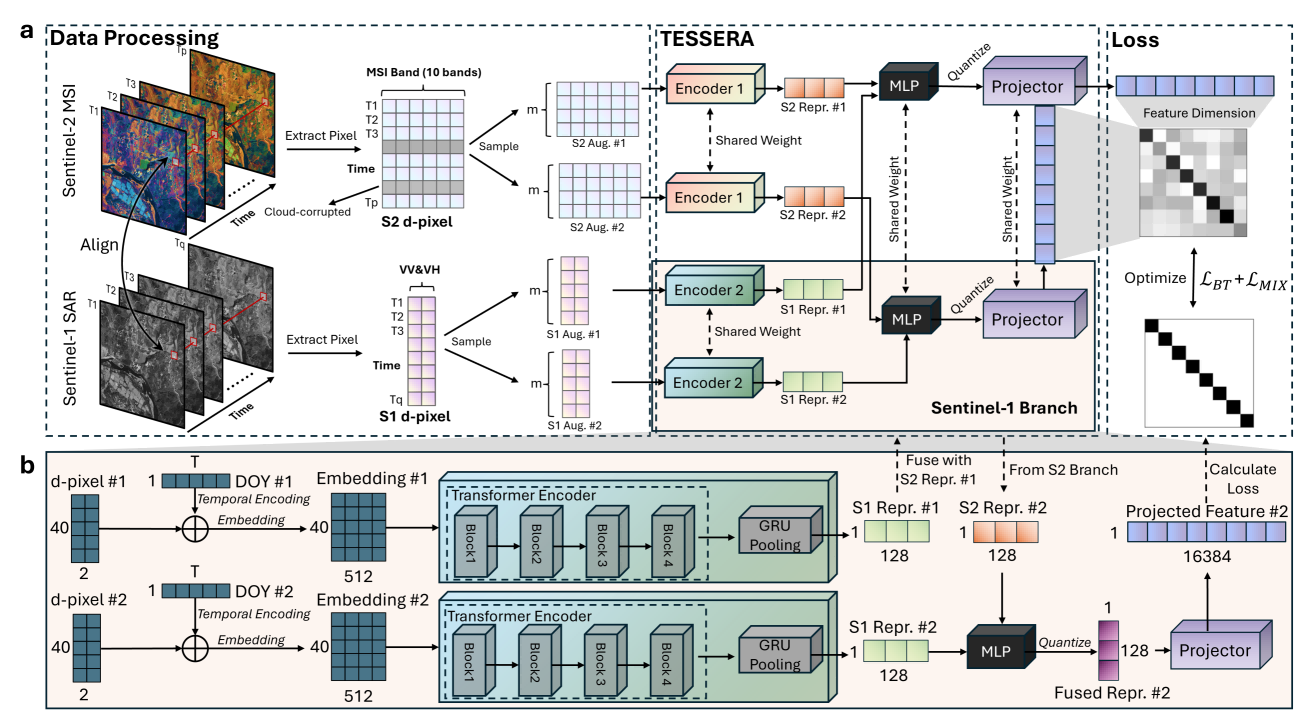
Applications of the TESSERA Geospatial Foundation Model to Diverse Environmental Mapping Tasks
Zhengpeng Feng, Clement Atzberger, Sadiq Jaffer, Jovana Knezevic, Silja Sormunen, Robin Young, Madeline C. Lisaius, Markus Immitzer, Toby Jackson, James Ball, David A. Coomes, Anil Madhavapeddy, Andrew Blake, Srinivasan Keshav
- Under review at Remote Sensing of Environment (RSE).
- Extension of the CVPR 2026 TESSERA paper with additional downstream tasks and more detailed analysis.
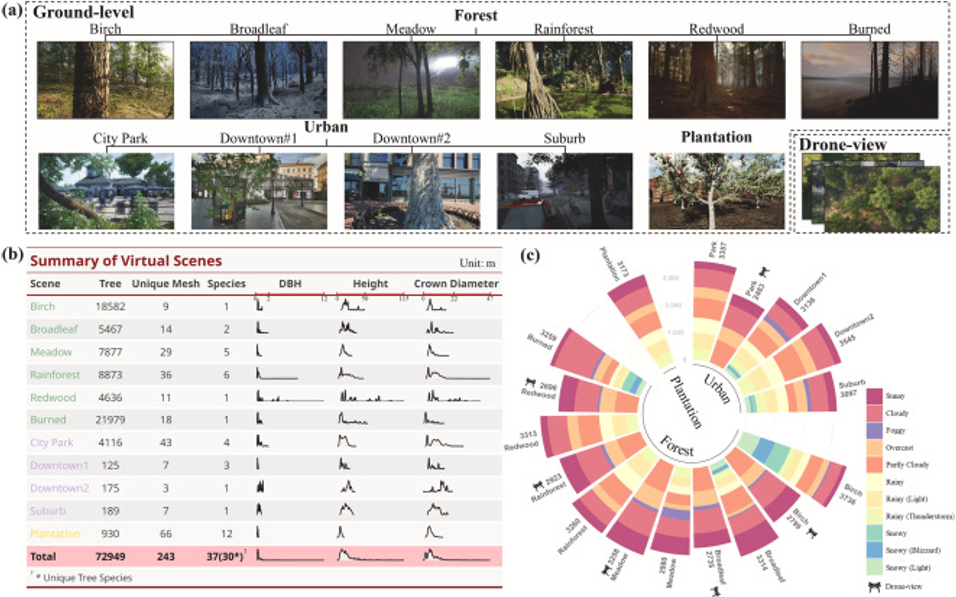
SPREAD: A large-scale, high-fidelity synthetic dataset for multiple forest vision tasks

Zhengpeng Feng, Yihang She, Srinivasan Keshav
- We used Unreal Engine 5 to create the super realistic synthetic data for 2D and 3D vision tasks in forests.
An app for tree trunk diameter estimation from coarse optical depth maps

Zhengpeng Feng, Mingyue Xie, Amelia Holcomb, Srinivasan Keshav
- An app for fast in-situ tree trunk diameter estimation.
- The app won the Cambridge Ring Better Future Award!
- More about the app
🎖 Honors and Awards
- 2025.09 Heidelberg Laureate Forum Young Researcher
- 2025.03 Cambridge Ring Better Future Award
- 2024.06 Robert Sansom Studentship
- 2022.12 The Most Outstanding Students Award of UESTC (top 10)
- 2022.11 Gratitude Scholarship for Chinese Modern Scientists
- 2022.10 National Scholarship
📖 Educations
- 2024.10 - Present, PhD in Computer Science, Department of Computer Science and Technology, University of Cambridge.
- 2023.07 - 2024.07, Research Assistant, Department of Computer Science and Technology, University of Cambridge.
- 2019.09 - 2023.06, B.Eng. in Spatial Informatics and Digitalized Technology, University of Electronic Science and Technology of China (UESTC).
💬 Invited Talks
-
2025.12, TESSERA: Precomputed Fair Global Pixel Embeddings for Earth Representation and Analysis, IEEE GRSS. [link] -
2025.12, TESSERA, RISE. [video] -
2025.10, TESSERA, GEDI Group, University of Maryland. [link] -
2024.06, An App for Tree Trunk Diameter Estimation from Coarse Optical Depth Maps. [video]
💻 Supervisions
- 2025.03 - 2025.06, Part IB CST Artificial Intelligence, University of Cambridge.